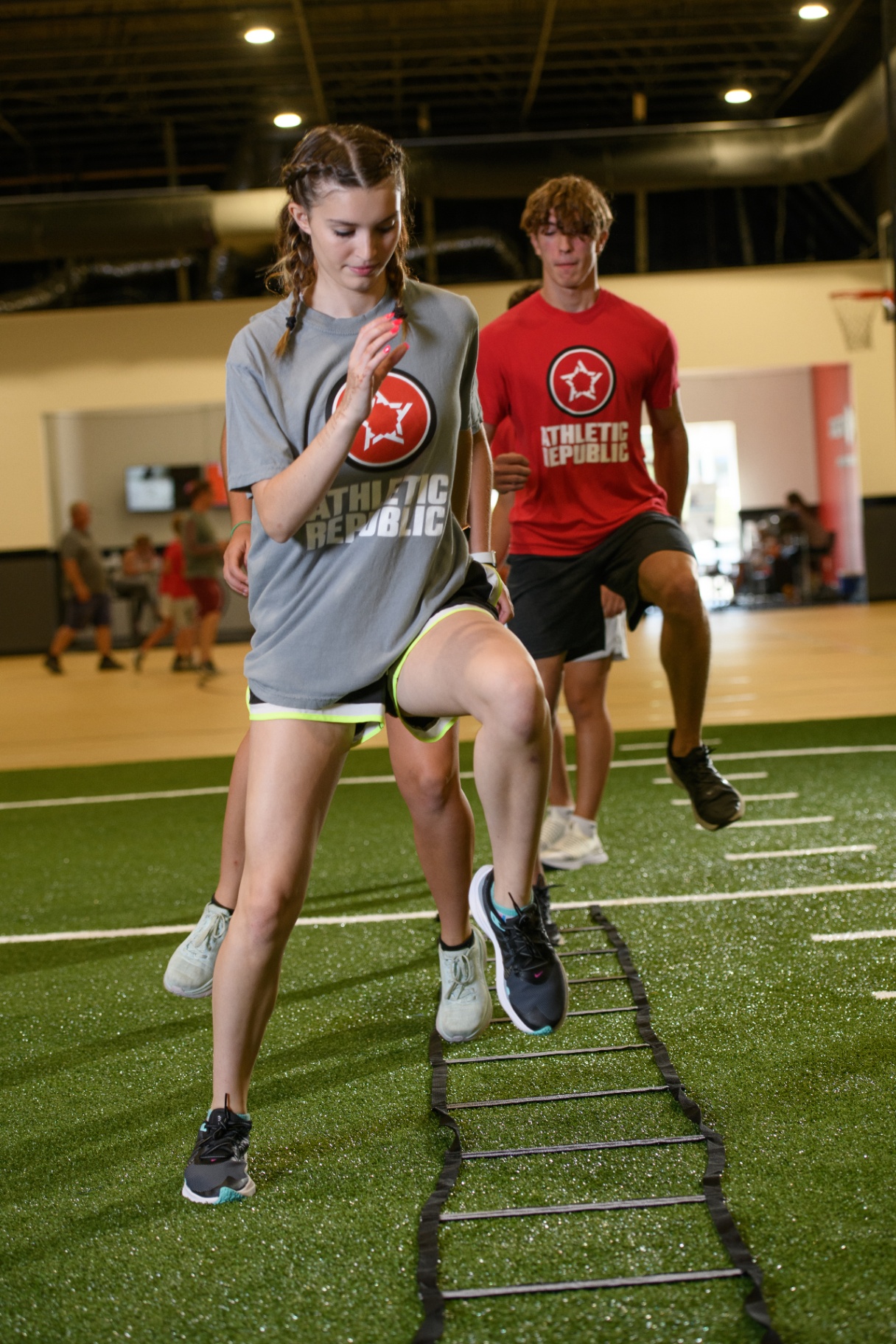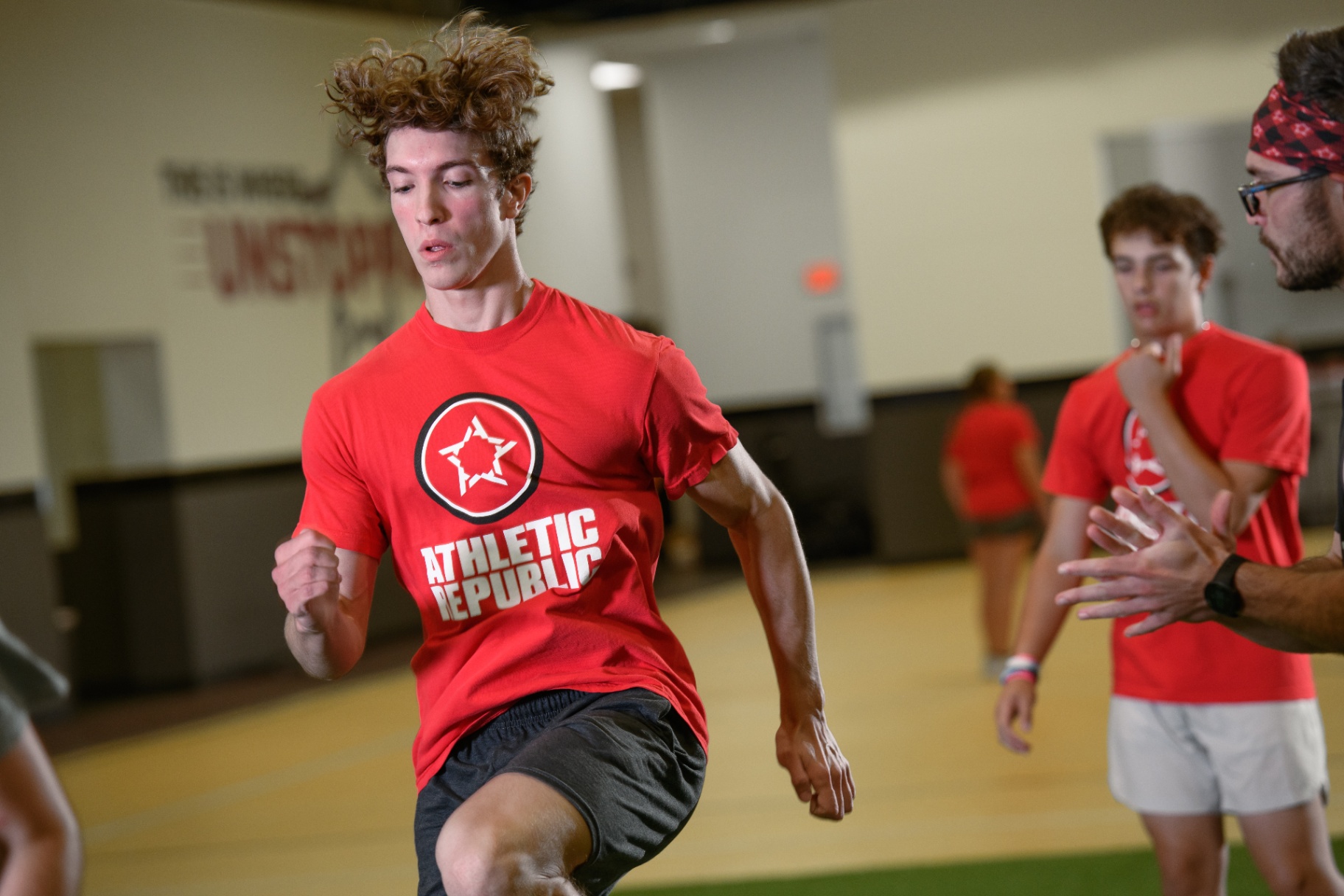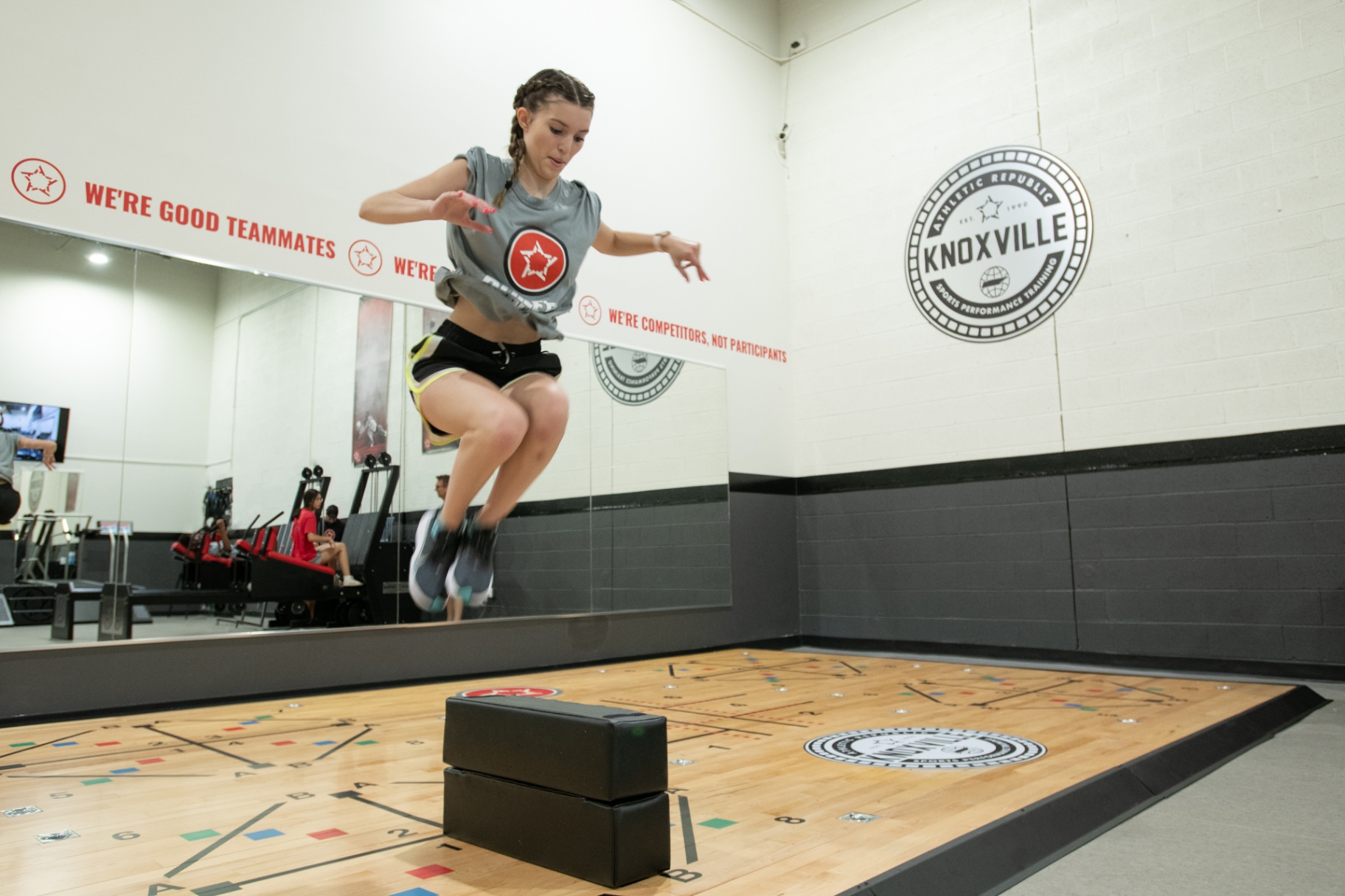
When athletes talk about getting faster, the conversation often goes straight to the 40-yard dash.
It makes sense. The 40 is familiar, easy to understand, and widely used in football and other sports. But in most game situations, athletes rarely get 40 uninterrupted yards to show what they can do. More often, they have a few feet, and a few seconds, to react, separate, close space, stop, cut, and go again.
That is why the first three steps matter so much.
At Athletic Republic Knoxville, our Acceleration training is not built around chasing one impressive sprint time. It is designed to help athletes become quicker, more controlled, and more explosive in the moments that decide plays. For a basketball guard, that may mean getting past a defender. For a soccer player, it may mean arriving first to a loose ball. For a football athlete, it may mean creating separation off the line. For an adult athlete, it may mean moving confidently and efficiently during competition or training.
The goal is not to promise a starting spot. Coaches make those decisions based on the entire athlete. The goal is to help athletes prepare with the movement skills, power, confidence, and readiness to make a stronger case when opportunities come.
Why the first three steps are more important than top-end speed
Top-end speed is valuable, but it is not always the quality that shows up most often in competition.
A game is full of short bursts:
- A first step toward an open passing lane
- A three-step acceleration to beat an opponent
- A quick shuffle before a defensive closeout
- A controlled stop before changing direction
- A sharp plant and re-acceleration into space
- A short chase after a rebound, ball, or loose puck
In each example, the athlete who can create force quickly has an advantage. They do not need to reach maximum speed. They need to get moving immediately, control their body, and transition efficiently into the next action.
That is the difference between simply being able to run fast and being able to use speed in a sport.
An athlete may have a respectable 40-yard dash but still feel slow in games if their first step is inefficient, their posture breaks down, or they lose time when stopping and changing direction. Acceleration training addresses those smaller moments where space is won or lost.
Step one: Create force in the right direction
The first step sets up everything that follows.
A common mistake is standing up too quickly. When athletes pop upright out of a start, they often lose the forward angle needed to project their body. Instead of pushing powerfully into the ground, they take short steps without creating much forward movement.
Effective first-step mechanics generally include:
- A controlled forward body angle
- A strong push through the ground
- Coordinated movement from the ankle, knee, and hip
- A stable trunk
- Quick, purposeful arm action
- A foot strike that supports forward movement rather than braking
This does not mean every athlete should look exactly the same. Body structure, sport, training age, and individual movement patterns all matter. That is why coaching cannot be reduced to yelling “run faster.”
At Athletic Republic Knoxville, trainers look at how each athlete moves. The focus is on biomechanics and movement quality: how the athlete creates force, where they place their feet, how they control their trunk, and whether one side moves differently from the other.
Those details can make the first three steps more efficient without simply asking the athlete to work harder.
Step two: Build usable acceleration
The second step is where an athlete begins turning that initial push into meaningful movement.
This is especially important in sports where the difference between arriving first and arriving late may be measured in inches. An athlete does not necessarily need a longer stride. They need to apply force quickly while maintaining posture and coordination.
Acceleration training can help develop:
- First-step quickness
- Stride frequency
- Lower-body force production
- Knee drive and arm action
- Coordination under speed
- The ability to stay low and project forward
- Confidence in explosive movement
For younger athletes, the emphasis should remain age-appropriate and technique-focused. For experienced competitors, training can progress toward higher intensity, more demanding starts, and sport-specific movement patterns. For adults, the same principles can improve athletic movement, conditioning, and confidence without requiring a professional-athlete background.
The training should meet the athlete where they are.
Step three: Stay connected to the next action
The third step is not just about running faster. It is about maintaining the quality of the movement while preparing for what comes next.
In competition, athletes rarely accelerate in a perfectly straight line for long. They may need to:
- Break into a cut
- Transition laterally
- Slow down under control
- Respond to an opponent
- Reposition their hips
- Re-accelerate in a new direction
That is why Acceleration training at Athletic Republic Knoxville includes more than straight-line sprinting. Athletes work on the complete sequence: accelerate, decelerate, change direction, and accelerate again.
This helps athletes become more adaptable. They are not only practicing how to get moving. They are practicing how to move well when the situation changes.
Deceleration is a skill, not a pause
Many athletes spend a lot of time practicing how to speed up and very little time learning how to slow down.
But stopping is often the first step in changing direction.
Effective deceleration requires an athlete to lower their center of gravity, control their trunk, absorb force through the hips and legs, and place the feet in a position that allows them to redirect their body. If an athlete cannot control the stop, the next cut will usually be slower, less stable, or less confident.
Poor deceleration can also place unnecessary stress on the body. Movement quality matters not only for performance, but also for helping athletes manage the demands of cutting, landing, and changing direction.
At Athletic Republic Knoxville, trainers teach athletes to own the stop before asking them to explode into the next movement. That progression helps build control first, then speed.
Re-acceleration is where separation happens
After the plant, the athlete has to go again.
This first step out of a cut is one of the most valuable actions in many sports. It can help a defender recover, allow a soccer player to chase into space, or give a basketball player the burst needed to attack a gap.
Re-acceleration requires:
- A strong push from the planted leg
- Efficient hip and trunk positioning
- Quick repositioning of the feet
- The ability to redirect force
- Explosive power without losing balance
This is where strength and speed connect. Power is not simply how much force an athlete can produce. It is how quickly they can produce and apply that force in the direction the sport requires.
That is why Acceleration training includes plyometrics, strength work, speed mechanics, and agility progressions rather than relying on one drill or one piece of equipment.
A science-based plan starts with the athlete in front of us
Every athlete comes in with a different history, movement profile, and goal. A younger athlete may need foundational coordination and body control. A high school athlete may need sharper cutting mechanics before tryouts. A college athlete may need to address asymmetry or improve repeat-burst performance. An adult may want to move more confidently while building athletic fitness.
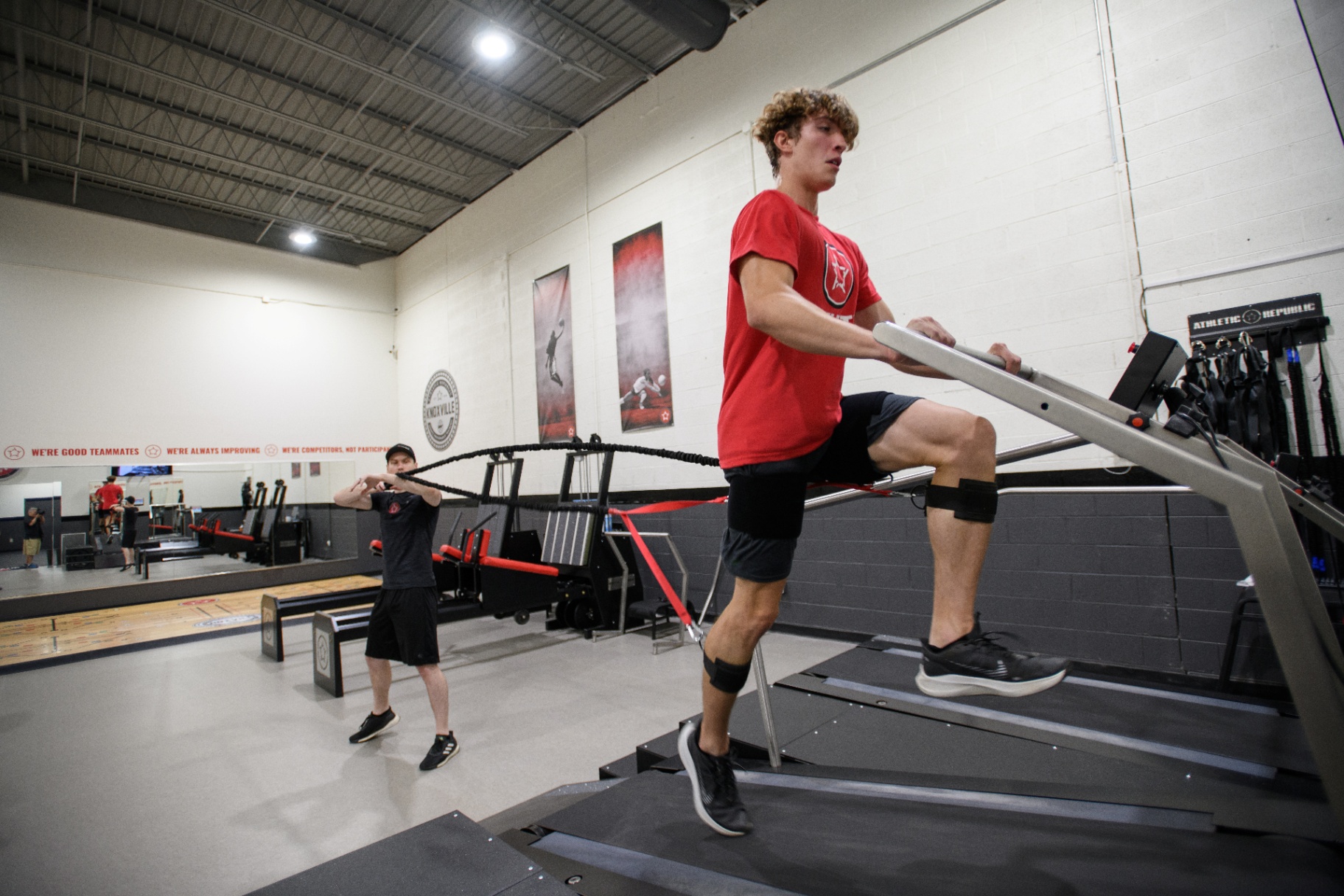
That is why Athletic Republic Knoxville uses a science-based process that includes:
- Baseline testing: Establishing a starting point and identifying strengths, limitations, symmetry, and areas for improvement.
- Biomechanical observation: Looking at posture, foot placement, force production, body control, and how an athlete transitions between movements.
- Individualized programming: Adjusting exercise selection, intensity, volume, and progressions to match the athlete.
- Movement-quality coaching: Teaching athletes how to accelerate, decelerate, cut, and re-accelerate with better control.
- Retesting: Measuring progress and using the results to guide the next phase of training.
This approach helps replace guesswork with a clearer plan. It also gives athletes something valuable beyond a faster drill time: confidence based on preparation.
Train for the moments coaches notice
Coaches notice athletes who consistently arrive on time, communicate, compete, and understand their assignments. They also notice movement.
The athlete who reacts quickly. The athlete who can stop under control. The athlete who changes direction without losing balance. The athlete who can make a second effort late in a play. The athlete who looks ready when their opportunity comes.
Acceleration training cannot guarantee a starting role, and no responsible program should make that promise. But it can help athletes prepare to respond when their number is called.
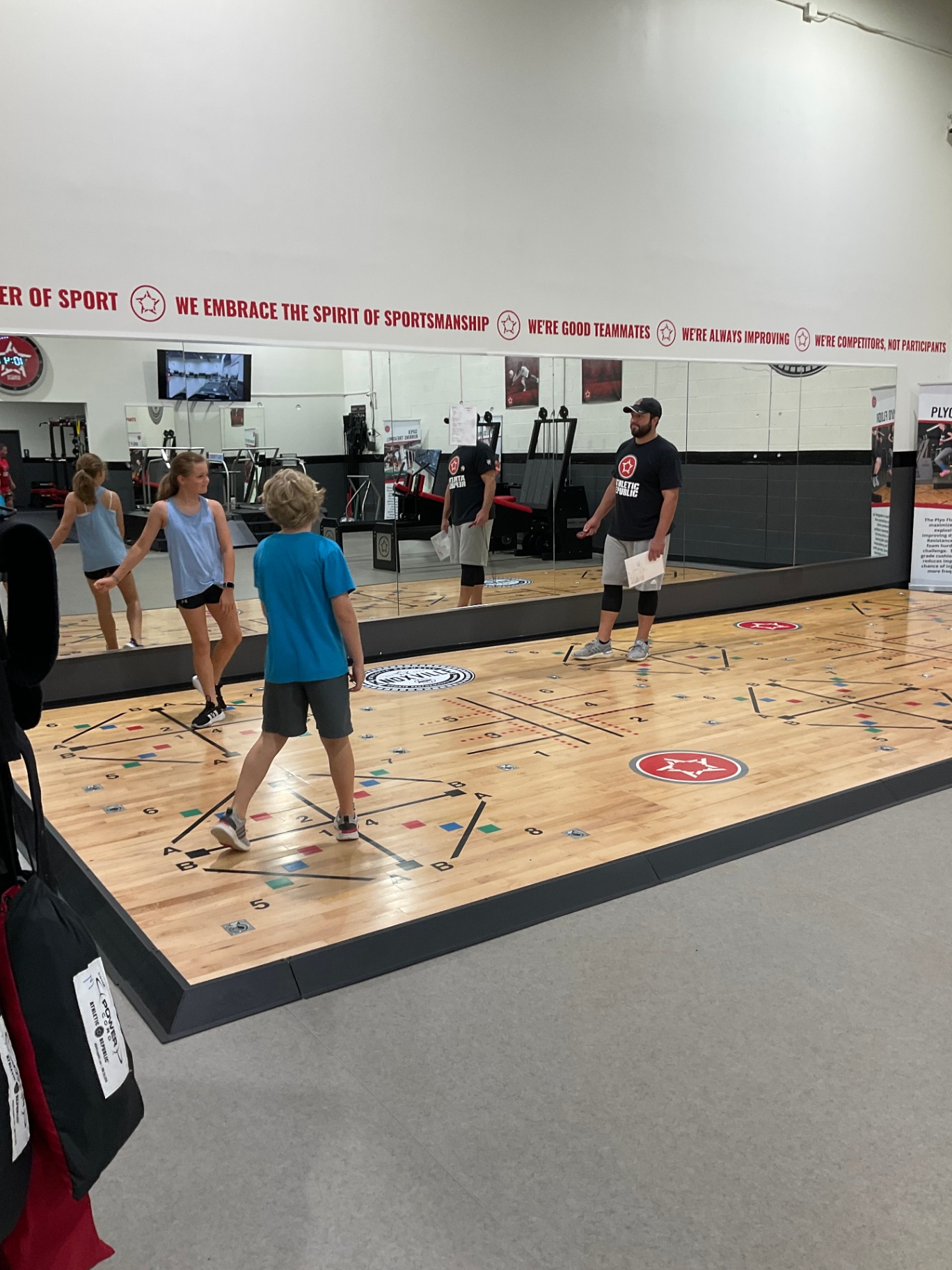
Inside Athletic Republic Knoxville’s 18,000 square foot facility, athletes train with certified coaches, performance-focused equipment, and protocols designed around long-term development. The environment is challenging, but supportive. Athletes are expected to work, learn, and improve, not to be perfect on day one.
Whether you are a parent supporting a youth or student athlete, a competitor preparing for a higher level, or an adult who wants to move with more power and confidence, the first three steps are a smart place to begin.
Ready to work on your first step?
Learn more about student-athlete training at Athletic Republic Knoxville and discover how Acceleration training can support speed, agility, power, and movement quality.
Then book a free workout at Athletic Republic Knoxville. We will help you understand where you are starting, what you are working toward, and how focused training can help you become more prepared for the moments that matter.